

Installation of wall-mounted air conditioners
Wall-mounted air conditioners consist of two units: an indoor unit and an outdoor unit. The first one is installed on the wall in the room where temperature regulation is required, from which the device got its name. The equipment shows the greatest efficiency in small rooms of apartments and houses, offices, stores with a small area.
Use of the air conditioner

In the assortment on the market it is easy to choose an air conditioner with a variety of functions that simplify the use of the equipment. Some features of the device are automated, and the user only needs to program their operation for a certain time.
Basic functions:
- timer for switching on and off;
- modes of ventilation, dehumidification and filtration of indoor air;
- remote control by means of a remote control;
- cooling and heating of the room.
Some models are controlled via mobile devices. The user sends commands via an app, the connection is made via the home Wi-Fi network.
If you have never used air conditioners for a house or apartment before, the available range will surprise you with its variety. Behind the beautiful words from manufacturers and elegant shell there may be a device that is not capable of performing basic functions to the proper extent.
Therefore, it is better to ask for help with the choice to the specialists of E-Engineering Co. We’ve been in the residential, commercial, and industrial air conditioning business for over 12 years and know exactly what features to look for and how to find a unit that won’t let you down in hot weather.
Types of equipment to be installed
Wall-mounted air conditioners are divided into two types according to the principle of operation:
- non-inverter;
- inverter.
The first category is devices that maintain a set air temperature by constantly switching the compressor on and off. If the value is lower than the one set by the user, the power unit is switched off, after which the room is naturally heated. As soon as the sensors detect an excess, the equipment is reactivated. Air filtration is carried out simultaneously with this cycle.
The inverter type is more modern. The compressor of such a system does not stop. The electronics of the device maintains the temperature in the room by regulating the speed of rotation. This makes the equipment much quieter, and power consumption is also reduced. The user also saves money due to the long service life of the air conditioner – the absence of constant restarts increases the resource of the device.
The equipment also differs in its design. For small rooms a monoblock installed in a window aperture is enough. The productivity of such a device is much lower, but it is enough.
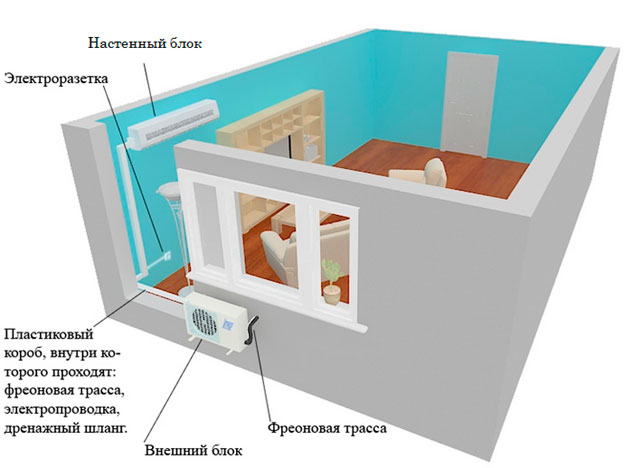
A more advanced analog is a split-system of two blocks:
- Outdoor. Installed outside so that repairs and maintenance can be carried out: close to windows, balconies or loggias. It contains the heat exchanger, compressor and fan.
- Interior. Located in the room where the climate desired by the user is set. It consists of a heat exchanger, a fan, and electronics to receive the signal and control the power unit.
Several copper tubes run in the wall, which transfer the refrigerant between the units. An electric cable is mounted next to them.
It is problematic to install a split-system by yourself. At least, you need to have a special tool and experience in setting up refrigeration equipment. Do not need unnecessary difficulties and expenses? Specialists of E-Engineering Co Ltd. will provide turnkey installation service. We will help you at all stages: we will select the climate technology with optimal characteristics and price, install it at the site, perform commissioning, and provide further service.